
| Index of articles from the Blog |
| Animals |
| Anthropology & Archaeology |
| Art & Cinema |
| Biography |
| Books & Authors |
| Culture |
| Economics |
| Environment |
| Fiction & Poetry |
| History |
| Humor |
| Justice |
| Philosophy |
| Photography |
| Politics |
| Religion |
| Science |
| Travel |
Books by
Books by
|






|
|
Herodotus
describes how it was that the king of Persia, Xerxes ("ruler of heroes",
son of Darius, grandson of Cyrus), decided to march upon Greece to 'bring
all mankind under our yoke, alike those who are guilty and those who are
innocent of doing us wrong.' The bitterness of Darius' defeat in the
battle of Marathon in 490 BCE was still fresh. When Xerxes presented his
case to an assembly of the noblest Persians, his deputy, Mardonius, who
'longed for adventures and hoped to become satrap of Greece under the
king,' exhorted him to action. Another confidante, Artabanus, his father's
brother, advocated caution and restraint. Torn as he was between the two
paths, Xerxes was haunted by a vision in his sleep of a tall handsome man
urging him to war. He ignored this at first and leaned towards Artabanus'
advice. However, the vision kept haunting him, growing more menacing with
each appearance. Greatly frightened, he summoned Artabanus and made him
don his regal attire, sit on his throne and sleep in his bed hoping that
the same vision would strike him. And it did. Artabanus woke up screaming
and adopted the majority opinion. Xerxes laid it all out before the
Persians—war it was to be. |
 |
Preparations
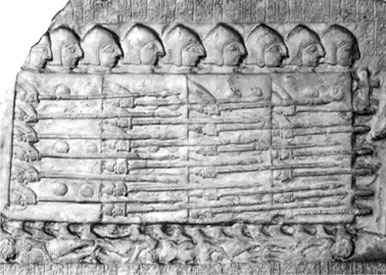
begin in earnest and take five years. A mighty polyglot army and a large
fleet is assembled under a single command with contingents from the far
reaches of the empire—Herodotus even mentions an Indian presence. (In
reality they are an ill-organized horde of tribes under effective command
of their native leaders.) Herodotus overestimated the numbers in Xerxes'
expedition, claiming over two-and-a-half million fighting men. While it
was certainly large, of the order of a few hundred thousand, his later
Greek sources must have exaggerated the numbers to make their own valor
and victory seem all the more heroic.
|
|
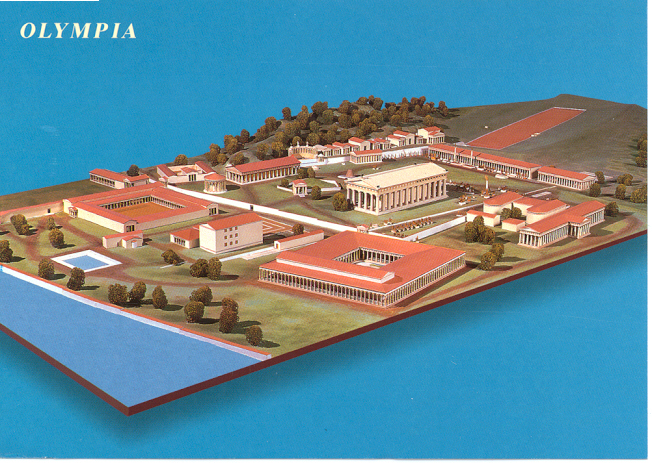
In 480 BCE, the Persian army bridges and crosses the Hellespont, the fleet follows along the coast. Heralds are sent to towns ahead with a demand for 'earth and water', and agreements secured to feast the king's entourage. Razing all opposition, Xerxes proceeds across Macedonia, and skirting Mt. Olympus enters Thessaly (the legendary home of Achilles). The logistics of provisions each night for his troops is nothing short of a Herculean task. Those who submit to his mammoth advance include the 'Thessalians, Dolopians, Enianians, Perrhaebians, Locrians, Magnetians, Malians, Acheans of Phthiotis, Thebans, and Boetians'. Further south, Greeks in Athens and the Peloponnese wrap up the Olympic games, postpone their quarrels, hold hasty meetings, and contemplate the future course of action. Envoys are sent to Syracuse to solicit support but the effort falls to pieces—the Sicilian tyrant Gelon wants the command of the combined defense forces, else he wouldn't help. |
|
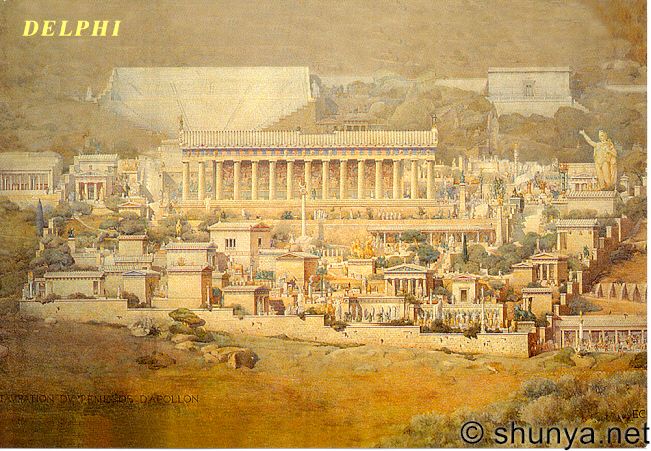
The
Athenians, now desperate, consult the Oracle at Delphi who urges
them in cryptic hexameter verse to build a 'wooden wall'.
Interpretations are debated but the one proposed by Themistocles,
the leading Athenian General, prevails and Athens diverts surplus
money from their silver mines to build two hundred (wooden) ships.
Athens henceforth becomes a naval power but is apparently still no
match for the gigantic Persian fleet. The balance is somewhat
redressed, however, when a number of Persian ships are destroyed by
a dreadful storm that rages on for three days.
|
 |
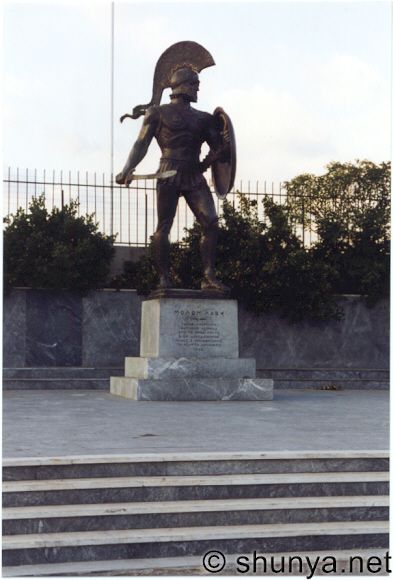 |
The first serious encounter takes place simultaneously on land and at sea near Thermopylae and Artemisium, respectively, a few hundred miles north of Athens. The Greek contingent represents many city-states and is led by the warrior Leonidas, king of Sparta and 'a descendant of Hercules' (Herodotus doesn't question this, even lists twenty ancestors in between). Xerxes is amused and dismayed by this small band of Greeks. But they offer heroic resistance and slaughter a disproportionate number of Persians while the Greek triremes accomplish startling victories at sea. However, superior numbers and an unexpected rear attack on the Greek army win the day for the Persians. Most Greek contingents withdraw but the Spartans stay and fight to the last man—the warrior Leonidas prefers heroic death to the stigma of defeat. The Greek fleet nursing heavy losses is also forced to retreat. |
|
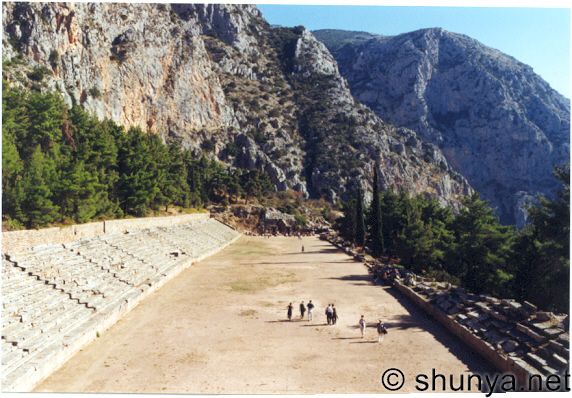
The
Persian army divides into two; one goes towards Delphi the other
towards Athens. The navy goes around Attica and towards Salamis, an
island across Athens' port Pireaus. The Delphians do a vanishing
act leaving only the priests behind. As the Persians approach the
sacred shrines, a series of supernatural incidents—thunder,
falling rocks, victory cries from the temples—strike fear in
their hearts and they flee; some are slaughtered by Delphians in
pursuit. Meanwhile, the Athenians hurriedly evacuate their city of
women and children and take refuge on neighboring islands including
Salamis. The Persians march into Attica, occupy Athens and plunder
the Acropolis. In Greece, only the Peloponnesian cities now stand
free. It is four months since the Persians crossed the Hellespont.
|
 |
Panic
strikes the Peloponnesian fleet as it prepares to withdraw further away
from Athens. Through some clever diplomacy and blackmail Themistocles gets
the Peloponnesians to stay at Salamis to meet the Persian advance ('either
you stay or we go and found a new city in the west',♣ while simultaneously sending a signal to dupe Xerxes into coming).
|
|
|
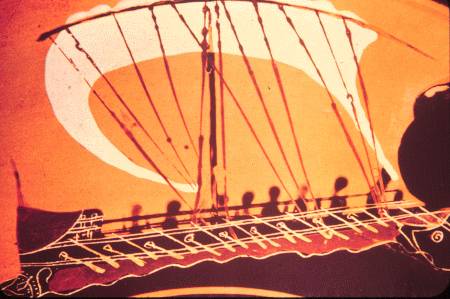
A tough battle ensues in the narrow straits of Salamis. The smaller, nimbler Greek triremes soon gain an upper hand over the Persian fleet. Fighting aboard a Persian ship is Artemesia, the consort of Xerxes. Artemesia distinguishes herself even when the Greeks win a decisive victory and rout the Persians. Xerxes, watching from afar, returns to Persia in disgust, leaving behind Mardonius to complete the task—'my men have behaved like women, my women like men!' |
 |
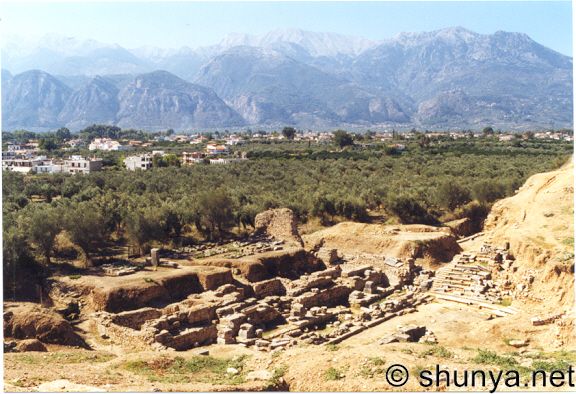
Herodotus comments on the culpability of the neutral 'nations' of the Peloponnese, |
|
 |
|
|
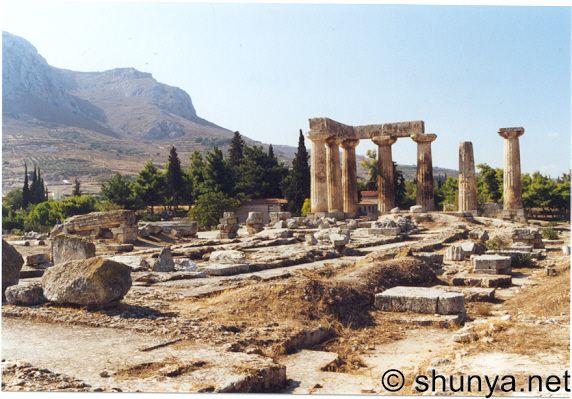
Next
spring, the Athenians again persuade the rest of the Greeks, using
open threats and keen diplomacy, to go on the offensive against the
Persians camping for the winter near Plataea. In pitched battles the
Greek hoplites defeat Mardonius' troops while the Athenian fleet
destroys the Persian armada. The Greeks have won against all odds.
The Spartans prevail on land, the Athenians at sea. Heralding their
rise and future hegemony, which would only end with the
Peloponnesian war, the Athenians begin the liberation of Asiatic
Greeks—a prelude to their subsequent colonization.
|
 |
The outcome has been attributed to the Greeks making fewer mistakes, to their fighting at home and for home against an ill-organized army of multi-lingual, under-motivated mercenaries, and to that essential Greek ingredient—good fortune. It was to become a favorite 'what-if' speculation for later generations—what if the Persians had won? |
|
| The Beginnings: Previous |
Next: The Greeks |
Designed in collaboration with Vitalect, Inc. All rights reserved. |
|