
| Index of articles from the Blog |
| Animals |
| Anthropology & Archaeology |
| Art & Cinema |
| Biography |
| Books & Authors |
| Culture |
| Economics |
| Environment |
| Fiction & Poetry |
| History |
| Humor |
| Justice |
| Philosophy |
| Photography |
| Politics |
| Religion |
| Science |
| Travel |
Books by
Books by
|





|
|
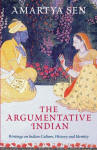
The Reach of Reason The Argumentative Indian: Writings on Indian Culture, History and Identity by Amartya Sen, Penguin, 432 pp., INR 295. |
May 2006 |
(This review was published in the International Journal on Humanistic Ideology, Vol. 2 No. 2 Autumn – Winter 2009)
1. Perceptions of culture, history, and identity are necessarily subjective and selective. There's no impartial and omniscient chronicler of events, no 'scientific' history. Facts are one thing, their interpretation another. As in Kurosawa's Rashomon, there are only particular interpretations of most facts, which may of course coincide at times. In this stirring book on the historical perceptions of India, Amartya Sen, noted scholar and Nobel laureate in economics, acknowledges this upfront with disarming modesty, while also signaling his attitude to his subject:
Soon enough though, Sen reveals his impatience with certain "other ways of proceeding". The India Sen presents to us has a long tradition of heterodoxy, openness, and reasoned discourse, a capacious India that is inclusive, tolerant, and multicultural. This contrasts with at least two major perceptions of India in modern times: (a) a Western and (derivatively) an Indian elite's stern view of India as "the land of religions, the country of uncritical faiths and unquestioned practices", and (b) the Hindutva, or the Hindu chauvinist's idea of India. To votaries of the first, Sen says, "it would be hard to understand the history of India [without its tradition of scepticism]". To see India "as overwhelmingly religious, or deeply anti-scientific, or exclusively hierarchical, or fundamentally unsceptical involves significant oversimplification of India's past and present." To support his view, Sen marshals evidence from the Vedas, the Upanishads, the Buddhists and the Carvakas, the Ramayana and the Mahabharata, Gupta-era science and mathematics, the intellectual links of the first millennium between India and China, the liberal-plural regimes of Ashoka and Akbar, the egalitarianism of Hindu Bhakti and Muslim Sufism, men like Gandhi, Tagore and Ray, etc. The modern West, contends Sen, emphasized "the differences—real or imagined—between India and the West," focusing on India's spiritual heritage at the expense of the rational one, partly because the West was naturally drawn to what was unique and different in India.
And while India might offer "examples of every conceivable type of attempt at the solution to the religious problem," Sen submits that they "coexist with deeply sceptical arguments ... (sometimes within the religious texts themselves)." Among his examples is the 'song of creation' of the Rig Veda, "the first extensive composition in any Indo-European language" (Wendy Doniger) and the radical doubts expressed therein.
Sen outlines three types of Western approaches to India: the exoticist, the magisterial, and the curatorial. He contends that these approaches, reinforcing each other, exaggerated "the non-material and arcane aspects of Indian traditions [over its] rationalistic and analytic elements." This, in turn, has strongly influenced the formation of the modern Indian identity. Sen's analysis is bracing and instructive, though he would have done well to add that few Westerners neatly adopt a single approach, most exhibiting a variable and fluid mix of them. With incisive wit and logic, Sen also combats the crude, insecure, and bellicose idea of a Hindu India promoted by the Hindutva movement (a brand of nationalism which at its peak was supported by less than 30% of all Hindus). He derides their pathetic attempts at rewriting history and inventing a glorified Hindu past that never was. He notes Hindutva's special appeal to many in the Hindu diaspora who are understandably "keen on taking pride—some self-respect and dignity—in the culture and traditions of their original homeland", and how it receives large remittances from them. In contrast, Sen exults in an India that has also long been home to Jains, Buddhists, Christians, Jews, Parsees, Muslims, Sikhs, Baha'is, and even atheists. To Sen, this historical heterogeneity and openness is a far worthier source of national pride.
He argues that "the problem with invoking the Ramayana to propagate a reductionist account of Hindu religiosity lies in the way the epic is deployed for this purpose—as a document of supernatural veracity, rather than as a 'marvellous parable' (as Tagore saw it)." The Hindutva brigade clearly shares this penchant with religious fundamentalists from around the world. Sen points out that even in the Ramayana, Rama is not a god but an epic-hero, "with many good qualities and some weaknesses, including a tendency to harbor suspicions about his wife Sita's faithfulness." In the epic, a pundit called Javali "not only does not treat Rama as God, he calls his actions 'foolish' ('especially for', as Javali puts it, 'an intelligent and wise man')". Echoing the beliefs of the materialistic school of ancient India, Javali even asserts that "there is no after-world, nor any religious practice for attaining that", and that "the injunctions about the worship of gods, sacrifice, gifts and penance have been laid down in the [scriptures] by clever people, just to rule over [other] people". Sen highlights a third major perception of India but does not much discuss it. This is the India of those
An alluring feature of Sen's writing is that perennially precious thing: commonsense. His commitment to civility, clarity, and precision is always evident. Most of the sixteen essays in this collection brim with a moral urgency and represent many of Sen's major thematic concerns of recent decades; they also reveal his abiding love of India. Still—exhilarating, insightful, and reasoned as The Argumentative Indian is—it is not balanced in much the same way that Edward Said's work isn't (many critics see strong affinities in their works, even though Said consciously avoided offering his own representations of Middle Eastern culture and history). At times it feels like a thinly veiled "self-respect and dignity" project for cosmopolitan India-lovers, but it also brilliantly achieves its main goal: to give a sturdy nudge to the leading perceptions of India and challenge historians and cultural critics to reexamine their assumptions. This is clearly no mean feat.
2. Unlike Naipaul—another Nobel laureate and influential interpreter of India—Sen doesn't see India's Muslim history largely as a wound. "It would be as silly to deny the barbarities of the invasive history [of the Muslims]," argues Sen, "as it would be to see this savagery as the main historical feature of the Muslim presence in India ... Muslim rulers, despite a fiery and brutal entry, soon developed—with a few prominent exceptions—basically tolerant attitudes." He cites Akbar, the Pathan kings of Bengal, Dara Shikoh, and another Akbar: the son of Aurangzeb who didn't share his father's intolerance and joined other Hindu kings, including the son of Shivaji (now a demigod to the Hindu chauvinists). There are nightmarish elements in the Muslim history of India, admits Sen, but "it also includes conversations and discussions, and extensive joint efforts in literature, music, painting, architecture, jurisprudence and a great many other creative activities." Sen admires Alberuni, the Persian scholar who, a thousand years ago, had mastered Sanskrit and traveled in India for 13 years, observing, reading, questioning, before writing his monumental history of India. Sen contrasts his approach with that of James Mill—the celebrated colonial historian who never visited India. Mill, quips Sen, "evidently didn't want to be biased by closeness to his subject matter". So it seems fitting that Macaulay—who held that "a single shelf of a good European library was worth the whole native literature of India and Arabia"—would be the one to discern in Mill's history of India "the greatest historical work ... since that of Gibbon". Sen frequently cites "Akbar's defence of a tolerant, pluralist society [and] his focus on the role of reasoning in choosing this approach." Akbar held that "reason cannot but be supreme, since even when disputing reason, we would have to give reason for that disputation." It may seem ironical that Akbar, a monarch who also led brutal wars of expansion, should feature so often in Sen's book. Ditto for Ashoka, whose edicts on public conduct and morality may well strike the modern reader as patronizing. Yet, situating them in their historical contexts, Sen makes a persuasive case that these men were far more enlightened than their global contemporaries. Sen is also impatient with "contemporary attacks on modernity (especially on a 'modernity' that is seen as coming to India from the West)". The attackers consider modernity a European cultural phenomenon—defined by peculiar notions like individualism, progress, secularism, and democracy—and they question its universality or suitability for the non-Western world. While at home with concepts like "reason" and "heterodoxy", Sen considers the notion of modernity "befuddling" and "irrelevant as a pointer of merit or demerit in assessing contemporary priorities". To those who see a problem with importing modernity in India (including Ashis Nandy), he responds with characteristic precision:
To those protective of the Indian masses against the "corruptions" of the West (Gandhi, for instance), Sen, like Tagore, "cannot bear to see the people eternally treated as a child." Instead, as Tagore said, it should be that "whatever we understand and enjoy in human products instantly becomes ours, wherever they might have their origin." For Sen, "the need to resist colonial dominance is, of course, important, but it has to be seen as a fight against submissive compliance, rather than as a plea for segregation and localism. The so-called 'post-colonial critique' can be significantly constructive when it is dialectically engaged—and thus strongly interactive—rather than defensively withdrawn and barriered."
3. Acknowledging India's "terrible record of social asymmetry" with respect to gender, class, and caste, Sen inquires "whether the tradition of [argumentation] has been confined to an exclusive part of the Indian population", the male elite that is, which would severely undermine "the social relevance of the argumentative tradition." He claims the answer here "is much more complex than a simple generalization can capture", and then proceeds to offer examples of women, minorities, and other disadvantaged groups registering their argumentative presence in Indian history and culture. But will these examples convince those who hold such identities? The contending words of Kancha Ilaiah loom large: "Nowhere in human history has one group—the upper castes of India—been able to oppress so many for so long." A vocal champion of democracy and open markets, Sen has argued elsewhere that "we cannot really take the high economic growth of Singapore or China as proof that authoritarianism does better in promoting rapid economic growth—any more than we can draw the opposite conclusion on the basis of the fact that one of the fastest growing countries in the world, Botswana [is a democracy]."♣ For Sen, democracy and open markets—combined with rational social policies—are the ideal means to liberal governance. When instituted from above, he notes, their success depends on a variety of local factors. He rightly points out the pivotal role of public reasoning for the success of democracy and claims that India's long argumentative tradition is strongly relevant to its own enduring democracy. He then adds:
Other conditions Sen considers important for the success of democracy include political equality and substantial social and economic equality. Political equality came one midnight hour in 1947. Sen believes that India's argumentative tradition is a powerful ally for advancing the cause of equality in the other two spheres. But almost sixty years later, the actual results, concedes Sen, have been mixed at best, even disconcerting, given the rise of divisive identity politics based on narrow affiliations of caste and religion, rising economic disparity (he finds the evidence on this conflicting), and the stubborn persistence of illiteracy, poverty, corruption, hunger and malnutrition, as well as caste, class, and gender based inequities. He maintains though that "what is really needed is a more vigorous practice of democracy, rather than the absence of it." But Sen doesn't say how to get Indians to practice democracy more vigorously. And while plausible, more evidence is needed for the primacy he assigns in its endurance to India's argumentative tradition. Another plausible theory assigns this credit to the famed tolerance of Indians—what Sen perceptively calls swikriti, or "'acceptance', in particular the acknowledgement that [others] are entitled to lead their own lives"—but to the underside of this good tolerance, the side that has long encouraged too many Indians to accept (rather passively) perhaps too much in life. This includes any inoffensive political system that came along (such as democracy), and which eventually fell in line with Indian cultural ways—a far cry from the textbook model for that system of governance. Sen also tackles globalization from his unique vantage point as an economist. Some fears about globalization, he says,
He warns us against the temptation to see globalization as a "one-sided movement that simply reflects an asymmetry of power which needs to be resisted." Throughout history, "different regions of the world have [benefited] from progress and development occurring in other regions." He points out that a millennium ago this movement occurred in the reverse direction—with "paper and printing, the crossbow and gunpowder, the wheelbarrow and the rotary fan, the clock and the iron chain suspension bridge, the kite and the magnetic compass," zero, the decimal system, and advances in mathematics—but he is conspicuously silent about how the unprecedented scale of today's globalization, with its pace and engine of change, instant flights of capital, rapid demographic shifts, and powerful corporations, might differ from that of an earlier age. Sen acknowledges that economic globalization poses risks to the vulnerable and the disadvantaged and his prescriptions appear close to the neo-liberal line: It's inescapable, so let's try to make it more humane and just. Rather than isolating itself or blaming the "shark" of globalization, India should get behind it and, through smart public policies, tackle specific ills that arise from it, as well as invest in education, health care, micro-credit, land reforms, women's education, and infrastructure (like energy, communication, transportation). He favors safety nets and well conceived social welfare programs that do less harm than good (who can disagree, but here Sen betrays no awareness that this old problem is known to ensnare even the best kind of reasoning). He has used part of his Nobel Prize money to fund development research in India and Bangladesh. He has persuasively argued that development should be measured not by GDP but in terms of "real freedoms people can enjoy." But Sen's analysis is not without its flaws. He writes: "Global economic interactions bring general benefits, but they can also create problems for many, because of inadequacies of global arrangements as well as limitations of appropriate domestic policies." If (a big if) these were addressed—Sen seems to suggest—economic globalization should create few problems. This is simplistic at best. Problems can also come from a culture's unpredictable response to it. What novel set of beliefs will it provoke? Will they be broadly liberal, rational, and conducive to economic success? Can we say how the dust will settle? The patient may get worse, or trade one serious illness for another. This recognition, far from turning us against globalization, makes us more realistic about its effects. Factoring in culture, Amy Chua, in her World on Fire, provides sobering examples that contrast with many of Sen's sanguine assumptions about "the crooked timber of humanity".
4.
Sen's primary objective in this work is to highlight the heterodox and rational aspects of India's past and present. Yet, he doesn't quite distinguish the 'heterodox' from the 'rational': two distinct and incidentally overlapping pursuits. For instance, the devotional Hindu and Muslim mystics he cites were heterodox (also syncretistic and egalitarian) but hardly rational—their arguments derived from a personal relationship to God rather than from reason. The term "Argumentative Indian" subsumes them both, but the question here is: besides contributing to diversity (the extent of which in India, Sen notes, had also baffled Churchill), what is heterodoxy worth without the underpinnings of reason? Notably, Sen's examples of rational Indians—outside the modern age and with the exception of Akbar's court—come to us from over a millennium ago (early texts, the epics, the Buddha, Carvaka, Ashoka, Aryabhata, etc.). This may fortify a rival claim that sometime in the last millennium, the rational-creative subculture of ancient India waned as Buddhism and Brahmanism gave way to devotional Hinduism and Islam, that mystical and orthodox beliefs fossilized Indian culture, making it appallingly disinterested in "subjects concerned with the here and now", that the British found an India without a sense of history, or interest in science, or a culture of disruptive innovation, that sporadic personal mutinies of this era grew into a million much more recently. Indeed, as Sen astutely admits, "there are other [reasonable] ways of proceeding" on such matters. But henceforth, few of them will be able to ignore this impassioned and stimulating labor of love. |
Designed in collaboration with Vitalect, Inc. All rights reserved. |
|