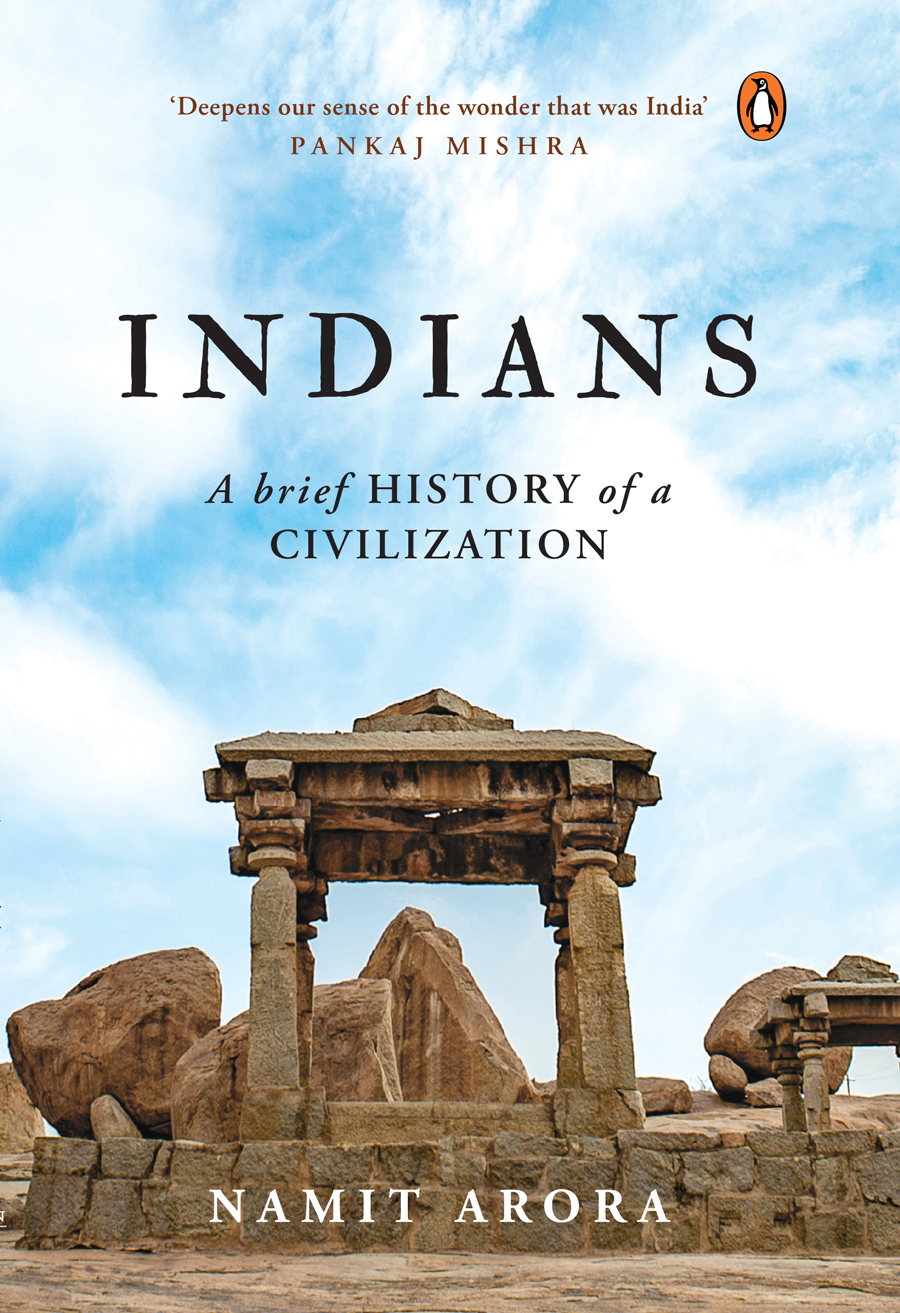
(A shorter version of this article appeared in the Jan 2011 issue of Himal Southasian. The author has revised some details and interpretations in a much expanded version included in Indians: A Brief History of a Civilization.)
 In December 2005, I took a bus out of the coastal city of Vijayawada in South India. Heading west, I passed small towns and villages whose names—opaque to me because written only in Telugu—I kept guessing at from a map. After years of regional drought, the monsoon had been bountiful this year. We passed field after verdant field of cotton and pepper in a region infamous for its depleted water tables and farmers fleeing to other regions, or committing suicide to escape debt. It took most of the morning, on three buses and an auto-rickshaw, to reach my destination: a village with tourist facilities near the ruins of Nagarjunakonda. In December 2005, I took a bus out of the coastal city of Vijayawada in South India. Heading west, I passed small towns and villages whose names—opaque to me because written only in Telugu—I kept guessing at from a map. After years of regional drought, the monsoon had been bountiful this year. We passed field after verdant field of cotton and pepper in a region infamous for its depleted water tables and farmers fleeing to other regions, or committing suicide to escape debt. It took most of the morning, on three buses and an auto-rickshaw, to reach my destination: a village with tourist facilities near the ruins of Nagarjunakonda.
A city flourished around 1,800 years ago at Nagarjunakonda (‘Hill of Nagarjuna’). A great religious and educational center of Brahmanism and Buddhism, one of the names it had then was Vijayapuri, after king Vijaya Satakarni of the Satavahana dynasty. Thereafter a capital of the Ikshvaku dynasty (225-325 CE), it fell into terminal decline after the demise of the last Ikshvaku king. It was only in 1926 that a teacher, S Venkataramayya, discovered the ruins of the ancient city. Much of it now lies under one of the largest manmade lakes in the world, Nagarjuna Sagar, formed in 1960 by the Nagarjuna Sagar dam across the Krishna River. Archaeological digs in 1926–60 turned up finds from the early Stone Age to medieval times, spread over 130 sites across 24 sq km. Many structures were moved and reassembled on what is now an island on the lake, as well as on the lake’s eastern bank at Anupu (much like the ‘saving’ of Abu Simbel from the Aswan Dam in Egypt).
The island’s modern name was inspired by one of the ancient city’s most illustrious citizens, Nagarjuna, a Buddhist monk-philosopher and founder of the ‘Middle Path’ school, who most likely lived there sometime in 150-250 CE. Called by some ‘the second Buddha’, Nagarjuna’s work is indispensable to several Buddhist schools, particularly Mahayana. ‘Nagarjuna’s philosophy represents something of a watershed not only in the history of Indian philosophy but in the history of philosophy as a whole,’ writes Douglas Berger, a scholar of Southasian thought, ‘as it calls into question certain philosophical assumptions so easily resorted to in our attempt to understand the world.’ [1]
§
 Not much is conclusively known about Nagarjuna’s life. Born into a Brahmin family, he later became a Buddhist. He likely traveled north and spent many years at a center of learning that later evolved into Nalanda University in modern-day Bihar. Many scholars consider his exposition of the concept of shunyata (‘emptiness’ or ‘voidness’) to be a critical achievement, central to a remarkable understanding of what it means to be human. Nagarjuna is best known for two works that have survived in Sanskrit: Madhyamika Karika (‘Fundamental verses on the Middle Way’) and Vigrahavyavartani (‘The End of Disputes’), ‘both critical analyses of views about the origin of existence, the means of knowledge, and the nature of reality.’[2] His work was not only a revival of the Buddha’s views on such topics—then losing ground to rival views—but also their further development. In the West, Nagarjuna’s ideas bear a striking resemblance to those of the later Wittgenstein. Not much is conclusively known about Nagarjuna’s life. Born into a Brahmin family, he later became a Buddhist. He likely traveled north and spent many years at a center of learning that later evolved into Nalanda University in modern-day Bihar. Many scholars consider his exposition of the concept of shunyata (‘emptiness’ or ‘voidness’) to be a critical achievement, central to a remarkable understanding of what it means to be human. Nagarjuna is best known for two works that have survived in Sanskrit: Madhyamika Karika (‘Fundamental verses on the Middle Way’) and Vigrahavyavartani (‘The End of Disputes’), ‘both critical analyses of views about the origin of existence, the means of knowledge, and the nature of reality.’[2] His work was not only a revival of the Buddha’s views on such topics—then losing ground to rival views—but also their further development. In the West, Nagarjuna’s ideas bear a striking resemblance to those of the later Wittgenstein.
The ‘Middle Way’ in Nagarjuna’s philosophy refers to the metaphysics of dependent origination, i.e., the idea that there is no objective, mind-independent reality that is accessible to us. This contrasts with the essentialist metaphysics of the self (atman) and reality (Brahman) that was prominent in his day, which posited that there is a true and universal reality that the human mind, with effort, can come to know. Nagarjuna argued instead that what we make of reality inevitably depends on the cognitive structure of our mind, rather than on anything we can identify as fundamental, innate, or essential attributes of reality itself (svabhava). There is no escape from our ontological categories, no firm foundation we can reach beneath the world of appearances. Indeed, we are stuck with our cognitive inheritance, which gives us our world of appearances. Our coming to this realization—akin to Wittgenstein’s idea of dissolving confusion—has profound implications for us. As our illusions fall away, we begin to regard ourselves as contingent beings, inextricable from a reality that we shape and which in turn shapes us, rather than as beings able to detach ourselves to contemplate reality as it truly is (the so-called ‘view from nowhere’).
 Nagarjuna’s real achievement was a rigorous analysis of phenomenon in order to reveal the incoherence of the idea that things possess an intrinsic nature, properties, or an eternal existence that do not depend on anything outside themselves. This is the concept of shunyata, or ‘emptiness’—a term that refers to the lack of autonomous existence, not nihilism or non-existence. Nor is there a Self, with an unchanging, innate essence. The Self is our own conceptual construct, with which we refer to a set of shifting psycho-physical states. That we rarely see things this way is a highly pragmatic self-deception that helps us survive. We can however recognize this and attain the right self-awareness through continuous practice. Though the Buddha first articulated these views, in Nagarjuna’s time they were held with suspicion. Nagarjuna’s careful exposition of these views made them respectable again, and they soon became foundational concepts in Mahayana Buddhism. Nagarjuna’s real achievement was a rigorous analysis of phenomenon in order to reveal the incoherence of the idea that things possess an intrinsic nature, properties, or an eternal existence that do not depend on anything outside themselves. This is the concept of shunyata, or ‘emptiness’—a term that refers to the lack of autonomous existence, not nihilism or non-existence. Nor is there a Self, with an unchanging, innate essence. The Self is our own conceptual construct, with which we refer to a set of shifting psycho-physical states. That we rarely see things this way is a highly pragmatic self-deception that helps us survive. We can however recognize this and attain the right self-awareness through continuous practice. Though the Buddha first articulated these views, in Nagarjuna’s time they were held with suspicion. Nagarjuna’s careful exposition of these views made them respectable again, and they soon became foundational concepts in Mahayana Buddhism.
Nagarjuna rejected the idea of an ineffable reality outside the grasp of the conceptual schema that we are heir to as survival-minded creatures (that idea would be a back-door way of attributing an essence to reality). Rather, it is meaningless to speak of an ineffable reality, or of anything outside our conceptual schema. To Nagarjuna, says Jan Westerhoff—author of Nagarjuna’s Madhyamaka, a recent and brilliant work of scholarship—‘our conceptual framework is to be thought of not so much as a map of a country, but as a set of rules for a game’. And why, for instance, it is meaningless to speak of a gambit in a game of chess that cannot be described by the notations of that game.[3] Our concepts too are part of the game we play to make sense of reality, and they give shape to and frame our understanding—we cannot access what lies beyond our own concepts. Or as Wittgenstein put it, ‘Whereof one cannot speak, thereof one must be silent.’
 What sort of epistemology can work with the idea of dependent origination or ‘emptiness’? One that is contextualist, in which investigative procedures are a means of knowledge only in given contexts. To Nagarjuna, epistemology and ontology feed upon each other. As Westerhoff says, Nagarjuna ‘sets out to establish that nothing can be regarded as intrinsically a means or object of knowledge. Means of knowledge and their objects have to be mutually established: the means of knowledge establishes the object by giving us cognitive access to it, and our successful interaction with the object establishes the means of knowledge as a trustworthy route to the object. Something will therefore be classified as a means or object of knowledge not because of its intrinsic nature, but because it is regarded as such once a reflective equilibrium has been reached.’[4] What sort of epistemology can work with the idea of dependent origination or ‘emptiness’? One that is contextualist, in which investigative procedures are a means of knowledge only in given contexts. To Nagarjuna, epistemology and ontology feed upon each other. As Westerhoff says, Nagarjuna ‘sets out to establish that nothing can be regarded as intrinsically a means or object of knowledge. Means of knowledge and their objects have to be mutually established: the means of knowledge establishes the object by giving us cognitive access to it, and our successful interaction with the object establishes the means of knowledge as a trustworthy route to the object. Something will therefore be classified as a means or object of knowledge not because of its intrinsic nature, but because it is regarded as such once a reflective equilibrium has been reached.’[4]
And so there is no ultimate truth about how things really are, only conventional truth, one that exists within the context of commonly accepted practices and justified belief. That said, not every conventional truth is equally subjective or valid. Some conventional truths can be judged better than others, based on how well they correspond to our interests and practices, or reduce pain and suffering. For instance, when we claim that a fruit tastes more ‘acidic’ than another, we rely on conventional standards based on our shared sense of taste—there is no ‘ultimate truth’ of the fruit tasting acidic outside the human mind. Further, conventional truths can often be improved—as determined by a shared meaning of ‘improve’—by operating under the illusion that we are chasing eternal truths. To Nagarjuna, says Westerhoff, we invariably arrive at our truths
 ‘... through our linguistically formed conceptual framework. But we shouldbe wary of denigrating these conventions as a distorting device which incorporates our specific interests and concerns. The very notion of ‘distortion’ presupposes that there is a world untainted by conceptuality out there (even if our minds can never reach it) which is crooked and bent to fit our cognitive grasp. But precisely this notion of a ‘way things really are’ is argued by the Madhyamika to be incoherent. There is no way of investigating the world apart from our linguistic and conceptual practices, if only because these practices generate the notion of the ‘world’ and the ‘objects’ in it in the first place. To speak of conventional reality as distorted is therefore highly misleading, unless all we want to say is that our way of investigating the world is inextricably bound up with the linguistic and conceptual framework we happen to employ.’ [5] ‘... through our linguistically formed conceptual framework. But we shouldbe wary of denigrating these conventions as a distorting device which incorporates our specific interests and concerns. The very notion of ‘distortion’ presupposes that there is a world untainted by conceptuality out there (even if our minds can never reach it) which is crooked and bent to fit our cognitive grasp. But precisely this notion of a ‘way things really are’ is argued by the Madhyamika to be incoherent. There is no way of investigating the world apart from our linguistic and conceptual practices, if only because these practices generate the notion of the ‘world’ and the ‘objects’ in it in the first place. To speak of conventional reality as distorted is therefore highly misleading, unless all we want to say is that our way of investigating the world is inextricably bound up with the linguistic and conceptual framework we happen to employ.’ [5]
‘For Nagarjuna the conception of truth [as] the way things really are presents a subtle object of clinging and thereby ultimately a source of suffering. Such clinging is not as coarse as clinging to possessions, to one’s body, or to one’s self, but it still generates a kind of attachment which in turn supports a sense of selfhood as a subject who has realized the way things really are. For the Madhyamika, in order to become truly selfless, one has to give up the view that we can obtain anything more than conventional truths, some of which might be evaluated as better than others but none of which can constitute the last word. The resulting epistemic humility is therefore a product of considerations of selfhood and ethics seen as interlinked with considerations of truth and reality.’ [6]
***
 Nagarjunakonda is now a popular day-trip from Hyderabad. For most visitors, the highlights seem to be the scenic ferry ride across the lake to the island, and picnic with family and friends under a shady tree on the lawns. The walk to the scattered ruins of stupas, temples, monasteries, burial sites, a university, and an amphitheater, makes for a pleasant yet haunting excursion. There is even a spot where the founder of the Ikshvaku dynasty performed Ashvamedha, a ritual horse sacrifice of the Vedic religion, usually commissioned by major kings. A bathing ghat on the lake, built in the style of the ancient city, is a fitting place to rest and imagine the city at its prime: its street life, homes, people. What was Nagarjuna like as a person, in the eyes of his family and friends? What kind of society and intellectual culture bubbled up a thinker like him? What was it like to sit in on doctrinal debates, where rival schools of thought waged battle with each other? He gave us deep insights into how we arrive at our most cherished beliefs. This understanding, it seems to me, is not only conducive to humility, it emphasizes the need to be always alert to context in our interaction with and judgment of others. Nagarjunakonda is now a popular day-trip from Hyderabad. For most visitors, the highlights seem to be the scenic ferry ride across the lake to the island, and picnic with family and friends under a shady tree on the lawns. The walk to the scattered ruins of stupas, temples, monasteries, burial sites, a university, and an amphitheater, makes for a pleasant yet haunting excursion. There is even a spot where the founder of the Ikshvaku dynasty performed Ashvamedha, a ritual horse sacrifice of the Vedic religion, usually commissioned by major kings. A bathing ghat on the lake, built in the style of the ancient city, is a fitting place to rest and imagine the city at its prime: its street life, homes, people. What was Nagarjuna like as a person, in the eyes of his family and friends? What kind of society and intellectual culture bubbled up a thinker like him? What was it like to sit in on doctrinal debates, where rival schools of thought waged battle with each other? He gave us deep insights into how we arrive at our most cherished beliefs. This understanding, it seems to me, is not only conducive to humility, it emphasizes the need to be always alert to context in our interaction with and judgment of others.
A museum on the island holds many exquisite sculptures, artifacts, and archaeological data on the ancient city. It was perhaps during Nagarjuna’s time that the Buddha, over half a millennium after his death, was starting to be depicted anthropomorphically—the Buddha’s own opposition to turning him into an idol was being forgotten. Many facets of material life appear in the sculptures from this period, including bas-reliefs depicting jataka-stories, palace interiors, court scenes, devotees, voluptuous singers and dancers, women holding food and drinks, children at play, war scenes, tree nymphs, and more. The uniquely eclectic Gandhara style is evident in many artworks even this far south. Despite frenetic excavations before the dam’s inauguration in 1960, one has to wonder how much of the ancient city still lies submerged under water, perhaps lost to us forever.
 In this museum too, the Archaeological Survey of India, as is its custom, prohibits the photography of works excavated with taxpayer money and with no evident copyright claims. Why? Nobody has a good answer. ‘Orders from above’ is the most common. ‘Apply for a permit in Delhi,’ said the curator. As per my own custom, I tried to sneak in a few photos, but an overzealous guard, sensing my intent, followed me around. I thought of offering him a bribe but then got distracted by the question: In my place, what would Nagarjuna have done? In this museum too, the Archaeological Survey of India, as is its custom, prohibits the photography of works excavated with taxpayer money and with no evident copyright claims. Why? Nobody has a good answer. ‘Orders from above’ is the most common. ‘Apply for a permit in Delhi,’ said the curator. As per my own custom, I tried to sneak in a few photos, but an overzealous guard, sensing my intent, followed me around. I thought of offering him a bribe but then got distracted by the question: In my place, what would Nagarjuna have done?
Notes:
- Nagarjuna. Internet Encyclopedia of Philosophy, 2005. Text by Douglas Berger, professor of philosophy and a specialist in Indian thought at Southern Illinois University.
- Nagarjuna. Encyclopedia Britannica, 2010. Text by Frederick J. Streng (1933-93), professor of philosophy at Southern Methodist University and second president of the Society of Asian and Comparative Philosophy.
- Nagarjuna’s Madhyamaka: A Philosophical Introduction, by Jan Westerhoff, OUP 2009, p 207.
- Ibid., pp 16-17.
- Ibid., p. 220.
- Ibid., p. 224.
Photographs:
- Nagarjuna Sagar lake
- Ruins of Simhala Monastery
- Amphitheater in the university complex at Anupu
- Hindu temple
- Pillar detail in the university complex at Anupu
- Bathing ghat
More photographs of Nagarjunakonda?
More writing by Namit Arora?
|