Why did democracy take root in India against all odds? What are its distinguishing features? What should we make of its attempts to combat inequalities among its people, especially via reservations? Over six decades later, how close is it to Ambedkar's inspiring vision of democracy?
 The Republic of India began life as an unlikely nation. Gaining independence in 1947, India adopted a democratic form of governance, a liberal constitution, and secular public institutions (at least in intent if often not in practice). None of these sprang from a living indigenous tradition.[1] Rather, they were chosen by an elite class of Indians that had developed a taste for them via its exposure to the West, and had even acquired some experience in representative self-rule in the closing decades of the British Raj. Many observers thought the experiment was doomed to failure. Among them was the stodgy imperialist Winston Churchill, who felt that if the British left, India would ‘fall back quite rapidly through the centuries into the barbarism and privations of the Middle Ages.’ Indians were unfit to govern themselves, and needed ‘the sober and resolute forces of the British Empire.’ The Republic of India began life as an unlikely nation. Gaining independence in 1947, India adopted a democratic form of governance, a liberal constitution, and secular public institutions (at least in intent if often not in practice). None of these sprang from a living indigenous tradition.[1] Rather, they were chosen by an elite class of Indians that had developed a taste for them via its exposure to the West, and had even acquired some experience in representative self-rule in the closing decades of the British Raj. Many observers thought the experiment was doomed to failure. Among them was the stodgy imperialist Winston Churchill, who felt that if the British left, India would ‘fall back quite rapidly through the centuries into the barbarism and privations of the Middle Ages.’ Indians were unfit to govern themselves, and needed ‘the sober and resolute forces of the British Empire.’
Doubters abounded for decades after independence. Unlike so many post-colonial nations, including those in South Asia, the continued existence of democracy in India—its fair elections and peaceful transfers of power—puzzled not just the lay observers, but it also became, according to historian Ramachandra Guha,
an anomaly for academic political science … That India ‘could sustain democratic institutions seems, on the face of it, highly improbable,’ wrote the distinguished political scientist Robert Dahl, adding: ‘It lacks all the favorable conditions.’ ‘India has a well-established reputation for violating social scientific generalizations,’ wrote another American scholar, adding, ‘Nonetheless, the findings of this article furnish grounds for skepticism regarding the viability of democracy in India.’ [2]
 The naysayers rightly saw democracy as an outgrowth of a particular historical experience in the West, rooted in a consciousness we now call modernity. They spoke of the conditions thought to be necessary for the flourishing of democracy: an egalitarian social order, an ethos of individualism, and a culture of secular politics and pluralist tolerance. India had mostly the opposite: a deeply hierarchical social order, subservience of the individual to family and community, and a culture of political quietism, though it did have a kind of tolerance (more on this below). Only a tiny class of Indians saw themselves as citizens of a nation-state, or could lay claim to political participation. Nor had the masses agitated to be rid of the hundreds of kings in as many princely states of British India, though discontent did exist in pockets. Indians were notoriously diverse, with identities spanning caste, class, region, custom, language, religion, and more, all impediments to a shared ideal of citizenship. Indeed, how was democracy expected to survive in such inhospitable terrain? The naysayers rightly saw democracy as an outgrowth of a particular historical experience in the West, rooted in a consciousness we now call modernity. They spoke of the conditions thought to be necessary for the flourishing of democracy: an egalitarian social order, an ethos of individualism, and a culture of secular politics and pluralist tolerance. India had mostly the opposite: a deeply hierarchical social order, subservience of the individual to family and community, and a culture of political quietism, though it did have a kind of tolerance (more on this below). Only a tiny class of Indians saw themselves as citizens of a nation-state, or could lay claim to political participation. Nor had the masses agitated to be rid of the hundreds of kings in as many princely states of British India, though discontent did exist in pockets. Indians were notoriously diverse, with identities spanning caste, class, region, custom, language, religion, and more, all impediments to a shared ideal of citizenship. Indeed, how was democracy expected to survive in such inhospitable terrain?
Democracy, With Reservations
 One Indian who anticipated these contradictions and worried about them was Dr. BR Ambedkar, the architect of the Indian Constitution. In his essay, Caste, Class and Democracy, Ambedkar astutely argued that once the British left, an Indian elite from the upper castes would simply step into their place. The right to universal adult suffrage alone wouldn’t make India a democracy—except in a narrowly technical sense—if the ‘servile classes’ in this deeply stratified society found no political representation. Ambedkar noted that the Indian political establishment, almost exclusively from the upper castes, despised the ‘untouchables’, and would neither strive to represent their interests, nor put up ‘untouchable’ candidates. Instead, they would hog all the power and resources and serve their own class interests. Ambedkar believed that ‘self-government and democracy become real not when a Constitution based on adult suffrage comes into existence but when the governing class loses its power to capture the power to govern.’[3] One Indian who anticipated these contradictions and worried about them was Dr. BR Ambedkar, the architect of the Indian Constitution. In his essay, Caste, Class and Democracy, Ambedkar astutely argued that once the British left, an Indian elite from the upper castes would simply step into their place. The right to universal adult suffrage alone wouldn’t make India a democracy—except in a narrowly technical sense—if the ‘servile classes’ in this deeply stratified society found no political representation. Ambedkar noted that the Indian political establishment, almost exclusively from the upper castes, despised the ‘untouchables’, and would neither strive to represent their interests, nor put up ‘untouchable’ candidates. Instead, they would hog all the power and resources and serve their own class interests. Ambedkar believed that ‘self-government and democracy become real not when a Constitution based on adult suffrage comes into existence but when the governing class loses its power to capture the power to govern.’[3]
Ambedkar realized that the Indian soil had to be fertilized to make democracy bloom. The ‘people’ in its definition—of the people, by the people, for the people—had to mean all people, not just the privileged classes. Further, what was needed for a healthy democracy was not just political equality but also substantial social and economic equality. Indeed, the former was not achievable without the latter—and would never be unless a society offered substantial equality of opportunity to all. With an eye to a fair deal and a level playing field for the ‘servile classes’, to which he himself belonged, Ambedkar argued for reservations—a form of positive discrimination, called ‘affirmative action’ in the United States—in public institutions, government jobs, and even in central and state legislatures.
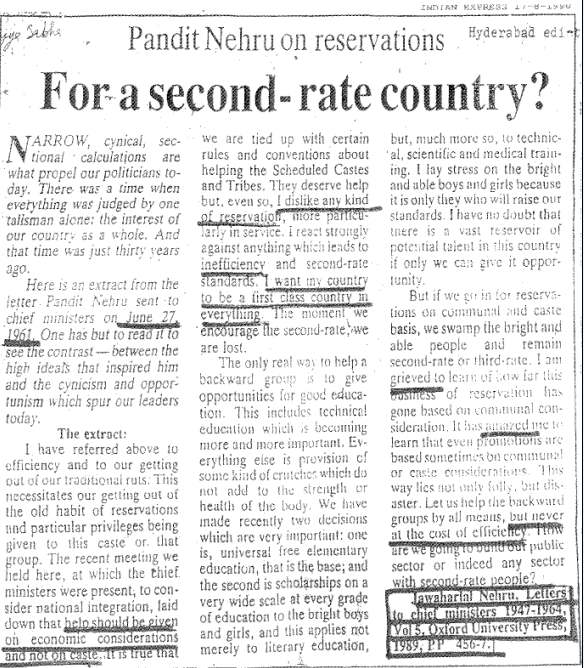
 Jawaharlal Nehru, the first Prime Minister of India, is often, and for many good reasons, held up as a great liberal democrat, who did a lot to inculcate and entrench democratic impulses in India. In his own words, he was ‘eager and anxious to change her outlook and appearance and give her the garb of modernity.’ Nehru was, however, opposed to the idea of reservations. He saw them as divisive—perhaps led by the view that the existence of separate Hindu and Muslim electorates was partly to blame for the bloody Partition. But he had other grounds to resist them as well. In 1961, he wrote: Jawaharlal Nehru, the first Prime Minister of India, is often, and for many good reasons, held up as a great liberal democrat, who did a lot to inculcate and entrench democratic impulses in India. In his own words, he was ‘eager and anxious to change her outlook and appearance and give her the garb of modernity.’ Nehru was, however, opposed to the idea of reservations. He saw them as divisive—perhaps led by the view that the existence of separate Hindu and Muslim electorates was partly to blame for the bloody Partition. But he had other grounds to resist them as well. In 1961, he wrote:
I dislike any kind of reservations ... I react strongly against anything which leads to inefficiency and second-rate standards. I want my country to be a first class country. The moment we encourage the second rate, we are lost. … [I]f we go in for reservations on communal and caste basis, we swamp the bright and able people and remain second rate or third rate. … This way lies not only folly, but disaster. Let us help the backward groups by all means but never at the cost of efficiency.
 Surely not Chacha Nehru's finest sentiment. He, too, rather simplemindedly, sees reservations as something opposed to quality of work and efficiency (more on this soon). A decade earlier, however, he had agreed to reservations for the ‘untouchables’ and the tribal peoples, referred to in the Constitution as Scheduled Castes (SC) and Scheduled Tribes (ST), respectively. They made up nearly a quarter of the population and the Constitution reserved for them 22.5 percent of the seats in the central and state legislatures. Reservation for Muslims and women was debated but rejected, a tacit acknowledgement that the plight of the outcastes and the tribals was uniquely bad. Beaten down and lacking self-confidence, the SC/STs now had a practical means of advancing themselves. Their political consciousness grew hand in hand with them realizing the power of the vote and their special rights under the Constitution. Surely not Chacha Nehru's finest sentiment. He, too, rather simplemindedly, sees reservations as something opposed to quality of work and efficiency (more on this soon). A decade earlier, however, he had agreed to reservations for the ‘untouchables’ and the tribal peoples, referred to in the Constitution as Scheduled Castes (SC) and Scheduled Tribes (ST), respectively. They made up nearly a quarter of the population and the Constitution reserved for them 22.5 percent of the seats in the central and state legislatures. Reservation for Muslims and women was debated but rejected, a tacit acknowledgement that the plight of the outcastes and the tribals was uniquely bad. Beaten down and lacking self-confidence, the SC/STs now had a practical means of advancing themselves. Their political consciousness grew hand in hand with them realizing the power of the vote and their special rights under the Constitution.
A striking feature of the Indian democratic experiment has been the increasing use of reservations to achieve greater social justice and equality of opportunity. Much of this has occurred not due to the goodwill of the elites but due to the shifting balance of political power across demographics. Since the 1950s, at least in some states, political power has been shifting away from upper-caste Hindus to the rest, who are far more numerous. From a society where public politics has long been marginal and a preoccupation of the few, India has become an intensely political society. By the 1970s, following the green revolution, many Shudra castes had gained enough socioeconomic clout to aspire to, and agitate for, a larger share of administrative and educational opportunities, where they were clearly underrepresented. Some of the largest and best-organized Shudra castes were the ‘Yadavs in Uttar Pradesh and Bihar, Jats in Haryana and Punjab, Marathas in Maharashtra, Vokkaligas in Karnataka, and Gounders in Tamil Nadu.’ [4]
 An artifact of this social change was the Mandal commission of 1979, tasked to “identify the socially or educationally backward” communities of India, and “to recommend measures, such as reservations in the administration, that could contribute to their social uplift.”[5] The commission designated these communities Other Backward Classes (OBC), and estimated them to be 52 percent of the population, including many socially backward Muslim groups. The report came out in late 1980 and was summarily ignored by the upper-caste leadership of the two Congress administrations in the 1980s. Its reservation policy recommendations had to wait until 1990 to be turned into law by Prime Minister VP Singh, an intellectual disciple of the anti-caste socialist Ram Manohar Lohia. An artifact of this social change was the Mandal commission of 1979, tasked to “identify the socially or educationally backward” communities of India, and “to recommend measures, such as reservations in the administration, that could contribute to their social uplift.”[5] The commission designated these communities Other Backward Classes (OBC), and estimated them to be 52 percent of the population, including many socially backward Muslim groups. The report came out in late 1980 and was summarily ignored by the upper-caste leadership of the two Congress administrations in the 1980s. Its reservation policy recommendations had to wait until 1990 to be turned into law by Prime Minister VP Singh, an intellectual disciple of the anti-caste socialist Ram Manohar Lohia.
Since 1993 India has reserved 27 percent of government jobs for the OBCs (but no seats in the legislatures, as for SC/STs) and since 2008, 27 percent of admissions to institutes of higher education that are ‘established, maintained or aided by the Central Government’.[6] Each educational institute was granted some leeway in choosing the eligibility cutoff for its admission, so they could strike the right balance between ‘excellence’ and ‘social justice’. In practice, this has led the institutes to set the cutoff too high and the OBC quota has gone unfilled for years, reverting to the general category as per the law. Based on financial thresholds, the quota also excludes a ‘creamy layer’ of ‘socially advanced’ OBCs. A performance review in ten years will propose adjustments. Notably, OBC reservation in employment applies only to initial recruitment, not to promotions (there is some support to enable the latter, at least for SC/STs, through a constitutional amendment). Including the 22.5 percent SC/ST quota, total reservation in government jobs and college admissions rose to nearly 50 percent. Not surprisingly, this provoked a huge backlash from upper-caste minorities—constituting less than 20 percent of the population nationwide—who saw their opportunities shrink.
Contrary to popular belief, reservations in India predate the Constitution by decades. Many socially conscious rulers of Princely States in south India—starting in 1902 with the Maharaja of Kolhapur, Chhatrapati Shahuji Maharaj, who dreamed of a caste-free society—had reserved public-sector jobs for marginalized groups in their domains. Others followed: The Maharaja of Mysore in 1921, the Bombay Presidency in 1931, the Maharaja of Travancore in 1935, and soon thereafter, the Maharaja of Cochin. In short, large parts of the South already had some form of reservations in public-sector jobs before 1947. Another common misbelief is that the Constitution limited all reservations to 10 years, whereas it did so only for political reservations (in state assemblies and the Lok Sabha), not for reservations in jobs and education, where the timeframe was kept open-ended and to be determined by outcomes.
The Reservations Debate
“To treat unequals as equals is to perpetuate inequality. When we allow weak and strong to compete on an equal footing, we are loading the dice in favour of the strong and holding only a mock competition in which the weaker partner is destined to failure right from the start.” (Report of the Backward Classes Commission, aka Mandal Commission, 1980.)
 In societies rife with entrenched inequality and discrimination, it is the penchant of the privileged to speak of open competition and difference-blind policies as virtues. Many, if not most, upper-caste Indians dislike caste-based reservations (with a bit more tolerance in the case of Dalits than for OBCs) and support only income-based reservations. However, they never seem to ask: if caste is a distinct vector of exclusion and oppression, how will income-based reservations counter it? Or consider another situation: let’s say our goal is to counter gender-based exclusion and oppression and to increase the representation of women in public life. Can income-based reservations achieve that goal, or will we need to provision gender-based measures? The same logic extends to caste. In short, each vector of disability that we intend to tackle requires positive discrimination along that vector. In societies rife with entrenched inequality and discrimination, it is the penchant of the privileged to speak of open competition and difference-blind policies as virtues. Many, if not most, upper-caste Indians dislike caste-based reservations (with a bit more tolerance in the case of Dalits than for OBCs) and support only income-based reservations. However, they never seem to ask: if caste is a distinct vector of exclusion and oppression, how will income-based reservations counter it? Or consider another situation: let’s say our goal is to counter gender-based exclusion and oppression and to increase the representation of women in public life. Can income-based reservations achieve that goal, or will we need to provision gender-based measures? The same logic extends to caste. In short, each vector of disability that we intend to tackle requires positive discrimination along that vector.
Clearly, there are better and worse ways of structuring reservations. But, above all, we need to stop thinking of caste-based reservations as a benefit only for Dalits, Adivasis, or OBCs. Reservations also benefit the upper castes by making the society they belong to more inclusive, one with greater social trust and cooperation. Per enlightened self-interest, if reservations make our institutions more representative and diverse, and our society more egalitarian, don’t we all benefit? Does it not behoove us to build a reservations regime—alongside other measures—to help achieve this goal?
In recent years, India has seen the entire gamut of critiques against reservations—from predictably shrill and crude takes on ‘merit’ and ‘reverse discrimination’ (which I’ve discussed in another essay, On Caste Privilege), to concerns that seem more reasonable but are often specious and no less crude. The latter include at least the following six variants:
Divisive identity Politics: Some critics claim that reservations fuel divisive identity politics. This argument tends to mix cause and effect. Identity politics primarily reflects—not causes—the serious social divisions and disparities that already exist, which won’t just disappear if ignored. Often in politics, identity formation and assertion by a weaker group are preludes to the group’s collective advancement, as in the Civil Rights struggle in the United States. In time and with sufficient assimilation, old identities tend to weaken or merge into new ones (a fear often cited here, exaggerated in my view, is that the lure of reservations may harden old identities, undermining the instrument’s progressive intent, but this is less an argument against reservations, more a plea to design them right, with periodic, data-driven reviews and adjustments based on outcomes for various groups).
A variant of this concern is that considerations of “caste good” are swamping those of “common good”, but did the latter ever exist in India? Won’t considerations of “caste good” remain paramount as long as there is casteist discrimination? -
A permanent entitlement: Other critics, including Sunil Khilnani, lament that reservations have become a permanent entitlement, rather than a temporary ‘stimulus package’ that needs periodic adjustments.[7] They wonder that when reservations have achieved the desired effect of ‘equalization of castes’, will the politicians have the wisdom and the courage to roll them back? This worry about the need for exit criteria seems legitimate, but it’s hardly a good reason to oppose reservations today; more often, this worry is a symptom of upper-caste conservatism and their thinly veiled opposition to reservations.
In general, reservations along a dimension make sense as long as discrimination remains a significant barrier to equality of opportunity and a large results gap exists along that dimension, whether of caste, gender, or another social grouping. Needless to say, not all barriers to equality of opportunity, nor all of the results gap (such as in high school graduation rates), can be addressed by reservations in public-sector jobs and higher education. Many other prior systemic barriers to equality of opportunity—as in persistent disparities in childhood nutrition, family income, access to quality primary and secondary schools, etc.—require their own focused remedies, which, in turn, can only amplify the reach and effectiveness of reservations later.
Reservations get hijacked by a handful of castes: It’s plainly true that among the wide range of OBC castes, not all are equally disadvantaged. Some dominant castes among the OBCs can, or may soon be able to, compete in the general category. To keep reservations the sharp and effective instrument of social justice that Ambedkar intended it to be, Dalit intellectual DR Nagaraj (1954-1998) emphasized the need to periodically “prepare a discriminating list of OBCs,” while lamenting that it’s “a task few are willing to undertake.” In 1993, soon after Nagaraj wrote that, the National Commission for Backward Classes (NCBC) was established to do just that—to periodically revise the list of castes and other groups eligible for reservations from over two thousand listed under OBC. The Commission’s obvious dilemma is that if this instrument of social justice lets a minority of eligible castes dominate the reserved category (with no timebound or other mechanism for them to make greater room for others who’re much worse off), it would not only have failed to advance opportunities broadly, it may well cause infighting over its “unfairness” and harm their collective interests.[8]
Indeed, to regard OBCs, or even Dalits, as a single group here is problematic. The ‘single group’ view may have strategic value when contesting upper-caste hegemony—akin to the nationalists representing ‘Indians’ as one group when contesting colonial hegemony—but it can also obstruct social justice in important ways. After all, if a reservation regime for SC/STs and OBCs remains blind to their internal hierarchies and levels of deprivation, it will most often propagate them. For instance, by the 1990s in Andhra Pradesh, the Malas came to dominate SC reservations at the expense of the Madigas and others. “A reservation policy that did not recognize disparities among the SCs of Andhra Pradesh actually reproduced the disparity,” wrote Dalit scholar K. Satyanarayana. [9] Following a struggle by the Madigas, in which they claimed a distinct caste and cultural identity—seeking, in effect, not the annihilation of caste but equalization of castes—the state subdivided the SC reservation quota among four new Scheduled Caste categories.
Even in U.P. and Bihar, post-Mandal OBC politics disproportionately benefited the Yadavs. Most coveted positions went to members of this caste, causing resentment among Kurmis, Lodhs, and other lower OBCs. ‘Yadavization’ of the state administration took precedence over forging solidarity and equality across OBC castes. According to scholar Braj Ranjan Mani, Dalit-Bahujan politics “remained tethered to group representation, not structural transformation… Social mobility, economic uplift, and political empowerment of a section of dalit-bahujans took place without threatening the existing hierarchies—as the fundamentals (the kernel of the caste system that reproduces hierarchies) were left intact.”[10] As Perry Anderson has observed, state elections “readily become ‘job auctions’ in which castes, often conglomerates of jatis cobbled together for the occasion, compete ferociously with one another for the spoils of office, in disregard of any logic of wider, let alone national solidarities.”[11]
But important as the beneficiaries’ perception of fairness is—especially in a corrective instrument of social justice—the reality is that, even with a more finely tuned reservations regime and a nimbler NCBC, not all castes will be able to take equal advantage of reservations. And invariably, the most privileged within a caste will benefit the most. This parallels how the admissions regime for foreign students in American universities, operating at the level of ‘national quotas’, disproportionately benefits the most privileged Indians. In 19th century India, when the British opened colonial schools for the locals, they disproportionately benefited the most privileged upper castes, mostly urban Brahmins. OBC and SC/ST reservations in India too, even without the nuisance of nepotism, may be able to reach only a few relatively privileged castes at first. That’s still better than reaching none.
Alongside, the NCBC ought to actively minimize conflicts and implement periodic reviews and adjustments. In March 2015, for instance, the Supreme Court upheld NCBC’s ruling that Jats be excluded from OBC reservations nationwide, though they had previously availed of OBC reservations in two states and many political parties, led by political expediency, had promised them more in their election campaigns. The NCBC also intends to ‘sub-categorize’ the OBC quota to prevent its domination by a handful of stronger groups, and to keep identifying newer forms of backwardness for inclusion under the OBC list, such as being orphan or transgender. Similarly, to reduce the domination of the general category by rich members from a handful of urban upper castes, it would be only fair to set aside a portion of it for the poor that are not covered by any other reserved category (i.e., college admissions based on parental income).
-
Use the market, not reservations: Some critics rightly point out how few public-sector jobs exist—a number that, in the post-1991 era of the market economy, keeps shrinking relative to the private and “unorganized” sectors, down to about 3-5 percent of all jobs. Given this reality, reservations, even after decades, can reach only a small minority of Dalits, Adivasis, and OBCs, not the least because few even possess the minimum educational qualifications needed for these jobs, such as about 10 percent of Dalits.[12] These critics argue that the market economy (and English language proficiency) is doing more to improve the lot of Dalits than reservations in the public sector, so why not drop reservations entirely, which are needlessly distracting and increasingly ineffectual. I think this argument has multiple fallacies.
First, it uses either-or logic, i.e., either markets or reservations, whereas both are effective and complement each other. Reservations make our institutions more diverse and representative of the public they serve, making them more responsive and less oppressive. This is unlikely to happen via free markets alone. Such institutions span non-elected bodies across law enforcement, judiciary, academia, planning bodies, water and electricity boards, industrial development corporations, public service commissions, and other state bureaucracies in banking, healthcare, media, and more. Until our public institutions and universities see the benefits of diversity and commit to it in their ranks (as is increasingly common in the United States, though far from perfect), we need reservations to help reach that outcome.
Second, given how few public-sector jobs exist, it’s a mistake to think of reservations as a job employment scheme. Rather, it’s a way of giving hitherto excluded communities a say in running their own government. As Kanshi Ram, the founder of Bahujan Samaj Party, exhorting OBCs in 1991, said, ‘reservation is not a question of our daily bread, reservation is not a question of our jobs, reservation is a matter of participation in the government and administration.’[13] It helps politicize a caste’s members, often a prelude to their collective empowerment. The few individuals who gain prominent public-sector jobs become sources of pride and role models in their communities. Concrete, material change comes thereafter, as some of these individuals translate their influence into new policies and actions.
Third, according to writer Chandra Bhan Prasad, former Naxalite who turned into an enthusiast of the market economy and is now an advisor to the Dalit Indian Chamber of Commerce and Industry, it was precisely these reservations in jobs and education that have "given Dalits a launch pad" in the modern economy. According to Prasad’s estimate, reservations had benefited about 5 million Dalit individuals by 2004. Counting the impact on their families and later generations, it may have brought 25 of 170 million Dalits into a higher socioeconomic class,[14] a modest but not an insignificant achievement. This despite the fact that in the early decades of the republic, SC/ST quotas in jobs and education largely went unfilled, whether “due to a lack of qualified candidates [in U.P. only 7.1 per cent were literate in 1961] … or a lack of willingness on the part of those in charge of filling them.”[13]
Finally, if public-sector jobs are shrinking, it may be time to also look at some form of reservations in the private sector, at least in corporations above a certain number of employees. India still has no legal provisions to combat discrimination in hiring, such as the Equal Employment Opportunity Act in the United States. Indian corporate managers have nominally “moved beyond” caste only to employ euphemisms like “family background”. Recent studies have “shown that employment discrimination is substantial, especially in the private sector, and that discrimination occurs to a large extent in unequal access to jobs.”[15] Despite equal job qualifications, employers in the modern private sector respond differently to resumes that have recognizable Muslim and Dalit names compared to those with upper-caste names.
-
Reservations lower excellence: A common view against reservations, one that Nehru held, is that quotas lower excellence. This of course relies on a silly, provincial idea of “merit”, based on test scores, degrees, or other “objective” measures that do not take into account the subjective-social context of most jobs, especially public-sector jobs. A truly meritorious system, say, in public health, policing, or banking, is one that understands those it serves, and responds to their needs equitably and without discrimination. The most satisfying public services value no less the providers’ social-emotional proximity to the served—not captured by standardized tests—than technical skills. In the United States, for instance, most cities no longer have a police force with predominantly white cops—a shift that has led not to a reduction in excellence but to its opposite: it builds trust and makes policing more effective (even as cell phone cameras suggest otherwise by revealing the still continuing, though broadly declining, abuses in policing, as in Ferguson, Missouri, 2014).
Ambedkar, a great believer in excellence himself, forcefully questioned simplistic ideas of merit with these words: ‘Nobody will have any quarrel with the abstract principle that [the best person for a job should be preferred]. But Man is not a mere machine. He is a human being with feelings of sympathy for some and of antipathy for others. This is even true of the best man. He too is charged with the feelings of class sympathies and class antipathies. Having regard to these considerations the ‘best’ man from the governing class may well turn out to be the worst from the point of view of the servile classes.’[16]
The same applies to all sorts of public services of the State. Can budget committees, planning commissions, or investment bodies make smart decisions without representative voices from a broad cross-section of society? Even the highly competitive Silicon Valley sees diversity as a key asset, because it leads to more creative, innovative, and successful solutions.[17] Reservations in our public sphere, by recruiting the best candidates from diverse social backgrounds, tend to improve overall excellence, not diminish it. Empirical evidence of this comes from a study on the Indian Railways, one of the largest public-sector employers in India. The study found ‘no evidence whatsoever’ that raising the proportion of SC and ST employees lowers ‘productivity or productivity growth. On the contrary, some of the results suggest that the proportion of SC and ST employees in the upper (A and B) job categories is positively associated with productivity and productivity growth.’[18]
Finally, it is also worth noting that nearly every institution of post-independence India has been spearheaded by Brahminical elites. Their dismal performance in delivering even basic social services to the majority of Indians—of education, health, water, sanitation, and electricity—says volumes about their “merit” and argues against leaving them in control of these institutions.
-
Reservations distract from real work: Another critique of reservations calls it a mostly symbolic politics of vote banks—the worst manifestation of identity politics—that has masked genuine debate over reform and development. According to political theorist Bhikhu Parekh, “[s]ocial justice has come to be defined almost exclusively in terms of reservations, and the massive programme of redistribution needed to tackle the deep roots of historically accumulated disadvantages has been marginalized. Rather than fight for such a programme, the scheduled caste, scheduled tribe, and OBC representatives in powerful positions use their constituents as a vote bank to promote their own careers.” [19]
If Parekh is right and reservations are little more than sops that distract from the larger task of social justice, we have a real problem and a failure of the political imagination on our hands. But is this a critique of reservations per se? Sure, there is an urgent need to ‘fight for such a programme’ but the fact is that the pursuit of social justice is not zero-sum. ‘On the contrary, it can be argued that: "the pursuit of justice in one dimension helps build a broader political culture that supports struggles for justice in other dimensions"’.[20] In other words, we can pursue reservations for historically disadvantaged groups as well as focus on redistributive socioeconomic justice by other means for the disadvantaged in all groups—these two goals are not mutually exclusive. Economist and politician, Meghnad Desai, has however identified one reason why this hasn’t happened, especially in north India:
‘The Indian State can deliver a nuclear bomb and launch satellites but not universal primary education or decent public health. This is not an accident. It is a choice made by the elite who have been in power for 60 years and reflects their values. [Even the] Indian socialists used the State to project elite power. The reason is that Indian society lacks a very basic element, which is present in most societies. This is the equality of respect, the basic idea that all human beings have equal status. Hindu society is a caste society and caste denies the simple idea of status equality. … The Indian State has been mainly manned by upper-caste elites and they do not consider the lower orders deserving of education and health.’[21]
§
 Supporters of reservations, including myself, argue that despite its design problems (e.g., the political difficulty of periodically scrubbing the list of eligible castes), instances of misuse (e.g., the upper castes using fake SC certificates), and implementation gaps (e.g., the upper castes finding ways to not fill quotas in education and jobs), reservations are still a valuable instrument of social justice, without which India will be even less likely to realize the full promise of democracy. Reservations are especially important in an India that has embraced Western models of economic development built on capital, professional education, and competition, thereby amplifying the historical advantages of the social elites. The debate on reservations may have added to the raucous unsettledness of the Indian polity, but it has also enabled more and more people from hitherto marginalized groups to participate in and fight for their idea of India. This is far more desirable than the reverse, and reservations remain an effective tool for redressing still-deep inequities and discrimination in Indian society. Supporters of reservations, including myself, argue that despite its design problems (e.g., the political difficulty of periodically scrubbing the list of eligible castes), instances of misuse (e.g., the upper castes using fake SC certificates), and implementation gaps (e.g., the upper castes finding ways to not fill quotas in education and jobs), reservations are still a valuable instrument of social justice, without which India will be even less likely to realize the full promise of democracy. Reservations are especially important in an India that has embraced Western models of economic development built on capital, professional education, and competition, thereby amplifying the historical advantages of the social elites. The debate on reservations may have added to the raucous unsettledness of the Indian polity, but it has also enabled more and more people from hitherto marginalized groups to participate in and fight for their idea of India. This is far more desirable than the reverse, and reservations remain an effective tool for redressing still-deep inequities and discrimination in Indian society.
In the same spirit, we should also applaud the ongoing initiative to reserve for women a third of the seats in the parliament and state legislatures (including a third of the SC/ST seats), where their numbers have stubbornly hovered near or below 10 percent, though many (mostly upper-caste) women have made it to the very top. The women’s quota is especially significant because a great many problems in India spring from the continued disempowerment of women. Curiously enough, the women’s reservation bill has extensive support from upper-caste elites. One wonders why their vehemence against caste-based reservations does not extend to gender-based reservations, when both caste and gender are sources of systemic disadvantage in Indian society. Is it because sisters and daughters in their midst help them overcome their empathy deficit?
The debate over reservations has perhaps grown more intense because it has also become a touchstone for the fairness of our public policies and the moral affinities of our politicians. However, to Parekh’s point, it is very important that Indians see reservations as only one in a bag of tricks to achieve greater social and economic equality. The stubborn persistence of inequalities that derive from illiteracy, hunger and malnutrition, lack of healthcare and sanitation, disparities in ownership of land in rural areas, uneven economic development, rising wealth and income gaps, and lax law enforcement suggests that India is nowhere close to realizing Ambedkar’s inspiring vision of democracy.
The Subsoil of Indian Democracy
Even today, India lacks the classic ingredients of modernity said to be necessary for democracy, nor is India about to acquire them in a hurry. How indeed has democracy survived in India? What aspects of Indian culture made it hospitable to democracy? I think two factors soar above all others: tolerance and cultural diversity.
Given India’s obsession with caste and other social hierarchies, it may strike some as strange to posit tolerance as an aspect of Indian culture. But tolerance comes in different flavors. Amartya Sen has called the Indian flavor of tolerance swikriti, or ‘"acceptance", in particular the acknowledgement that [others] are entitled to lead their own lives.’[22] Part of this no doubt comes from the presence of thousands of self-absorbed endogamous castes, each with its customary way of life; another part comes from India’s long history of cultural syncretism that has furthered many tolerant, pacifist, and private faiths, often alongside a gentle, dreamy, fatalistic detachment from the world. The tolerance of swikriti is therefore different from the tolerance of modernity; the latter has its roots in egalitarian individualism. Swikriti may also have extended to political systems that came along, at least the relatively inoffensive kind, such as democracy. As long as political power didn’t actively oppress, it was of marginal concern: rulers could come and go, dynasties rise and fall. To all but an elite class, democracy too began as yet another political experiment in a faraway city, later permeating the countryside and drawing sustenance from swikriti. There is, however, a fine line between swikriti and indifference. In The Annihilation of Caste, Ambedkar wrote:
"The Hindus claim to be a very tolerant people. In my opinion this is a mistake. On many occasions they can be intolerant, and if on some occasions they are tolerant, that is because they are too weak to oppose or too indifferent to oppose. This indifference of the Hindus has become so much a part of their nature that a Hindu will quite meekly tolerate an insult as well as a wrong … Indifferentism is the worst kind of disease that can infect a people. Why is the Hindu so indifferent? In my opinion this indifferentism is the result of the Caste System, which has made Sanghatan and co-operation even for a good cause impossible."
 No less crucial to the survival of democracy in India was the extraordinary diversity of the newly independent republic. What, after all, did denizens of Ladakh or Mizoram have in common with natives of Kutch or Coorg? But what good is such diversity if it impedes people from coming together in common cause? India’s history also shows that diversity has no causal relationship with material progress, rationalism, or social liberalism. Yet, cultural diversity, almost by definition, thwarts singular narratives of being, and acts as a formidable bulwark against political and religious fundamentalism. With so many competing claims and ways of life in India, democracy turned out to be particularly well suited as a practical means of resolving conflicts among various communities. No less crucial to the survival of democracy in India was the extraordinary diversity of the newly independent republic. What, after all, did denizens of Ladakh or Mizoram have in common with natives of Kutch or Coorg? But what good is such diversity if it impedes people from coming together in common cause? India’s history also shows that diversity has no causal relationship with material progress, rationalism, or social liberalism. Yet, cultural diversity, almost by definition, thwarts singular narratives of being, and acts as a formidable bulwark against political and religious fundamentalism. With so many competing claims and ways of life in India, democracy turned out to be particularly well suited as a practical means of resolving conflicts among various communities.
It’s possible to argue that swikriti and cultural diversity are receding in India, not the least due to an intensifying competition for limited resources, Hindutva nationalism, and economic globalization. But alongside, a more widely shared secular identity—and a sense of imagined community—have also emerged, forged by things like cricket, popular music, movies and soap operas, TV and print journalism, railways, education boards, competitive exams, a unified market, state institutions and their administrative borders. Many progressive, modernizing ideas of self and community increasingly penetrate Indian culture and civil society. New forms of tolerance and sociocultural diversity—as in new art, music, lifestyles, vocations, and identities—have also arisen. More than six decades later, a different question looms large: Is India becoming a sicker or a healthier democracy?
Notes:
- Ancient India did have many democratic republics. See Steve Muhlberger, Democracy in Ancient India, 1998.
- Ramachandra Guha, India after Gandhi, Harper Perennial, 2007, p 598.
- BR Ambedkar, The Essential Writings of BR Ambedkar, Oxford India Paperbacks, pp. 132-148.
- Guha, p 598.
- Christophe Jaffrelot, Religion, Caste and Politics in India, 2011, p 494.
- The Central Educational Institutions (Reservation in Admission) Act, 2006.
- Sunil Khilnani, From Representative Democracy, Live Mint, April 2010.
- Call for unity among Malas, Madigas, The Hindu, Sunday, Dec 30, 2007.
- K. Satyanarayana, Dalit Reconfiguration of Caste: Representation, Identity, and Politics, Critical Quarterly, Vol.56, No.3, October 2014: 46-61
- Braj Ranjan Mani, ‘The Crisis And Challenge Of Dalit-Bahujans’, 17 December, 2013, Countercurrents.org.
- Perry Anderson, ‘The Indian Ideology’, Three Essays Collective, 2012.
- Anand Teltumbde, The Persistence of Caste, Zed Books, 2010, p 70.
- Christophe Jaffrelot, Religion, Caste and Politics in India, 2011, p 538, 520.
- Chandra Bhan Prasad, A Business Case for Reservations, 16 November 2004.
- Sukhdeo Thorat and Katherine S. Newman, Blocked by Caste: Economic Discrimination in Modern India, Oxford, 2010, p 143.
- Babasaheb Ambedkar Writings and Speeches (BAWS): Vol. 2: 505-6.
- Fostering Innovation Through a Diverse Workforce, Forbes, July 2011.
- Ashwini Deshpande, ‘Social Justice through Affirmative Action in India’, February 2013. The study on Indian Railways is by Ashwini Deshpande and Thomas E. Weisskopf, “Do Reservation Policies Affect Productivity in the Indian Railways”, Centre for Development Economics Working Paper no. 185, May 2011.
- Bidyut Chakrabarty, Indian Politics and Society Since Independence, Routledge, p 71. This quote is by Bhikhu Parekh, cited by Bidyut Chakrabarty.
- Stanford Encyclopedia of Philosophy, Citizenship, April 2010.
- Meghnad Desai, ‘The Hindu rate of backwardness’, Indian Express, 28 July 2013.
- Amartya Sen, The Argumentative Indian, Farrar, Straus and Giroux, 2005, p 35.
Images:
- Courtesy Financial Times (source).
- Voters smile and show their ink-marked fingers after casting their ballots at a polling station at Pargi village, 120 km (75 miles) west of the southern Indian city of Hyderabad April 16, 2009 (Reuters/Krishnendu Halder) - source.
- BR Ambedkar.
- Nehru smoking with Edwina Mountbatten.
- Election poster showing Indira Gandhi (source).
- Prime Minister VP Singh, c. 1990
- A man displays the indelible ink mark on his index finger after casting his vote, outside a polling station in Sonapur village, about 30 kilometers (19 miles) east of Gauhati, India, Thursday, April 23, 2009. (AP Photo/Anupam Nath) - source
- A child looks on as Bahujan Samaj Party supporters listen to party president Mayawati at an election rally in Allahabad, India, Monday, April 20, 2009. (AP Photo/Rajesh Kumar Singh) - source
- A Muslim woman displays the ink mark on her finger after casting her votes in Rae Bareli, India, Thursday, April 30, 2009. (AP Photo/Rajesh Kumar Singh) - source
(This essay first appeared on 3 Quarks Daily.)
More writing by Namit Arora?
|